
Improving the efficiency of gear-driven machinery is a critical objective for mechanical engineers seeking to enhance performance, reduce energy consumption, and extend equipment lifespan. Gear systems inherently experience losses due to friction, misalignment, and vibration. Addressing these requires a multifaceted approach encompassing design optimization, material science, lubrication management, and operational protocols.

(how can you improve the efficiency of a machine that uses gears)
Gear Design Optimization
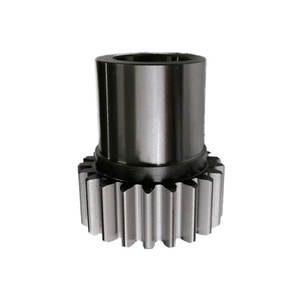
Fundamental efficiency gains start with precision gear design. Selecting the correct tooth profile is paramount. Modern involute profiles, when precisely manufactured to minimize deviations, reduce sliding friction and stress concentrations. Helical gears offer superior efficiency over spur gears due to gradual tooth engagement, lowering noise and vibration losses, though axial thrust must be managed. For high-load applications, hardened case-carburized gears with ground or honed teeth achieve surface finishes below 0.4 μm Ra, minimizing friction. Additionally, optimizing gear geometry—pressure angle, module, and helix angle—ensures even load distribution and reduces bending and contact stresses. Finite element analysis (FEA) should validate designs under operational loads to prevent tooth deflection and misalignment.
Material Selection and Surface Engineering
Material choice directly impacts wear resistance and fatigue life. Alloy steels such as AISI 4140 or 4340, heat-treated to RC 58-62, provide high core toughness and surface hardness. Advanced surface treatments like diamond-like carbon (DLC) coatings or nitriding reduce coefficient of friction by up to 50% compared to uncoated surfaces. For non-lubricated environments, polymer composites or sintered metals impregnated with solid lubricants offer viable alternatives. Implementing shot peening on gear teeth enhances fatigue strength by inducing compressive residual stresses, mitigating crack propagation.
Lubrication System Enhancement
Lubrication remains the cornerstone of gear efficiency. Synthetic oils with extreme-pressure (EP) additives outperform mineral oils, maintaining viscosity stability across temperatures and reducing boundary friction. Lubricant selection must align with operating conditions: high-viscosity oils for heavy loads, lower viscosity for high speeds. Oil churning losses can be minimized via optimized sump design or spray lubrication systems that target meshing zones precisely. Filtration (≤10 μm) is essential to prevent abrasive wear from particulates. Condition monitoring through oil analysis detects viscosity breakdown, additive depletion, or contamination, enabling proactive maintenance.
Thermal and Vibration Management
Power losses manifest as heat, accelerating wear. Efficient cooling systems—forced-air fans, oil coolers, or heat exchangers—maintain oil temperature below 80°C to preserve film strength. Structural rigidity of gearboxes prevents housing deflection under load, ensuring shaft parallelism. Critical shaft alignment within 0.05 mm tolerance minimizes parasitic losses. Vibration damping through precision balancing (ISO 1940 G2.5 standard) and anti-vibration mounts reduces noise and prevents fretting.
Maintenance and Operational Practices
Predictive maintenance protocols are indispensable. Vibration analysis identifies misalignment, imbalance, or bearing wear before failure. Thermography detects overheating in meshing zones. Regular inspection of backlash and tooth contact patterns ensures optimal engagement. Operators should avoid prolonged operation at resonant speeds and ensure gradual load application to prevent shock loading.
System Integration
Finally, gear efficiency cannot be isolated from the broader system. Coupling selection, bearing preload adjustment, and proper motor sizing (avoiding underloading) contribute holistically. Variable frequency drives (VFDs) enable speed modulation to match load requirements, reducing unnecessary gear operation at peak stress points.
(how can you improve the efficiency of a machine that uses gears)
In conclusion, elevating gear-driven machine efficiency demands a systematic integration of advanced design, materials, lubrication, and maintenance. By rigorously applying these principles, mechanical engineers can achieve efficiency improvements exceeding 5–8%, translating into substantial energy savings and operational reliability over the equipment lifecycle.