
Helical gears represent a critical advancement over spur gears in modern machinery, offering smoother operation, higher load capacity, and reduced noise due to their angled teeth. Manufacturing these precision components requires specialized machinery capable of generating the continuous helical tooth form. Several primary machine types dominate industrial helical gear production, each with distinct characteristics and advantages.
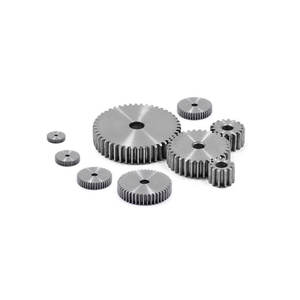
(what kind of machine curs helical gears)
The undisputed workhorse for volume production of helical gears is the CNC Gear Hobbing Machine. This machine utilizes a rotating cutting tool called a hob – essentially a worm gear with gashed flutes forming cutting edges. The fundamental principle involves synchronized rotation between the hob and the workpiece gear blank. As the hob rotates, the workpiece rotates at a precisely controlled speed ratio determined by the number of teeth being cut and the number of starts on the hob. To generate the helix angle, a critical additional motion is required: the hob or the workpiece must traverse linearly along its axis in perfect synchronization with the rotational movements. This simultaneous rotation and axial feed creates the necessary relative motion to cut the helical tooth flank. Modern CNC hobbing machines excel due to their precise control over all axes of motion (rotary and linear), enabling accurate helix angle generation, differential indexing for fractional tooth relationships, and optimized cutting cycles. They are highly versatile, capable of producing a wide range of helix angles, module sizes, and gear widths efficiently and are suitable for both external and internal helical gears.
For internal helical gears or gears located close to shoulders where hob access is restricted, CNC Gear Shaping Machines are often employed. Instead of a hob, these machines use a reciprocating pinion-shaped cutter. The cutter, which has the inverse form of the desired tooth space, moves vertically in a cutting stroke and a retraction stroke. Crucially, during the cutting stroke, the cutter and the workpiece rotate synchronously in a timed relationship, similar to meshing gears. To generate the helix, the cutter spindle is tilted to match the desired helix angle. As the cutter reciprocates and rotates, the workpiece rotates correspondingly. Simultaneously, a tangential feed motion (infeed) is applied radially to achieve the full tooth depth. While generally slower than hobbing, shaping offers excellent flexibility for internal gears, cluster gears, and complex profiles. Modern CNC shapers provide high precision and surface finish.
A more recent development gaining significant traction, particularly for hard finishing operations after heat treatment, is CNC Gear Skiving. Skiving utilizes a rotating cutter with a defined rake and clearance angle, similar to a shaper cutter but operating in continuous rotation rather than reciprocation. The key to helical gear generation lies in the crossed-axis configuration between the skiving tool and the workpiece. The rotational axes are set at an angle corresponding to the sum (or difference) of the helix angles of the gear and the tool. As both rotate in synchronized motion, the tool is fed radially and tangentially to generate the tooth form through a continuous cutting action. This crossed-axis setup inherently creates the relative motion necessary for the helix. Skiving offers high productivity, excellent surface finish, and the ability to finish hard gears with minimal distortion. It requires highly rigid machines and sophisticated CNC control to manage the complex kinematics accurately.
Beyond these primary methods, specialized processes like form milling (using a formed cutter matching the gear tooth space, requiring indexing after each tooth) exist but are generally limited to prototyping, repair, or very low-volume production due to lower accuracy and speed. Grinding is the primary method for achieving the highest precision and surface finish on hardened helical gears, utilizing similar kinematic principles as hobbing or shaping but with abrasive wheels.

(what kind of machine curs helical gears)
In conclusion, the mass production of high-quality helical gears relies predominantly on sophisticated CNC machines leveraging precise synchronized motions. CNC Gear Hobbing Machines remain the most versatile and efficient solution for external helical gears across a broad spectrum of applications. CNC Gear Shaping Machines provide essential capabilities for internal helical gears and complex geometries. CNC Gear Skiving Machines are increasingly vital for productive hard finishing operations. The choice among these advanced machines depends on factors like gear type (internal/external), volume, required precision, material hardness, and economic considerations, all underpinned by the fundamental requirement to accurately generate the controlled helix angle defining the gear’s performance characteristics.